Shopfronts and Blank Walls: What Changes on a Walk
Shopfronts and blank walls change how a route feels: learn to notice shifts in attention, walking pace and street character on an ordinary walk.
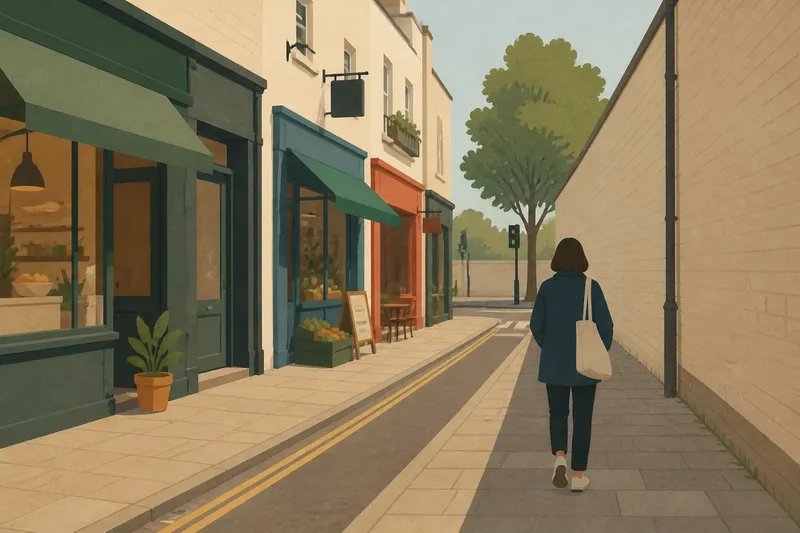
You pass a bakery window, a shuttered doorway and then a long stretch of pale brick before the next entrance appears. Shopfronts and blank walls make an ordinary walk feel different because they give your eyes, and your attention, different things to settle on. A simple week of short walks can help you notice how a street changes without turning the outing into a survey.
What does a street frontage ask you to notice?
An active frontage presents openings or details that face the pavement: a shop window, a café door, a lit lobby, a display, a sign or a window where someone is working. It need not be a busy business. A visible entrance and a changing view can make a building feel connected to the route.
A blank wall gives the eye fewer interruptions. It might be a plain side elevation, a closed service wall, a high fence or a long run of shutters. “Blank” describes the pedestrian’s view, not the purpose of the building. A wall may be necessary for privacy, storage or the building’s layout; the point here is how it meets the street.
Think of the difference as a book with occasional illustrations beside a page of uninterrupted text. The illustrations offer places for the eye to pause, while the plain stretch can make the line of the route feel more continuous. Neither is automatically better. A quiet wall can give a street composure, and a cluttered frontage can demand more attention than a passer-by wants to give.
How can you observe a route without rushing?
Choose a familiar, public street you can walk comfortably, and use the same short stretch for several outings. A block, a shopping parade or the approach to a station is enough. Keep to the pavement, respect private property and do not photograph people or look through windows. A small notebook or a note on your phone is plenty.
On the first walk, simply look ahead and notice where your attention goes. Do not try to count every door. Mark a few points where the view changes: a shop window begins, a blank wall ends, a doorway interrupts a facade or a tree covers the building line. Write down what you noticed and how the route felt at those points.
Then repeat the walk at a different time of day, such as on the way to work and later when shops are open. If the route is pleasant and conditions allow, try it on another day of the week. You are not trying to make a scientific comparison; you are checking which parts of the street change and which remain visually quiet.
Use this short routine as a guide:
- Before you set out: Choose one safe route and decide where you will turn back.
- On the first pass: Notice the first detail that catches your eye, then the longest uninterrupted stretch.
- At a change in frontage: Pause only where it is safe and convenient; note whether an opening, sign, doorway or blank surface changes your attention.
- On a later pass: Look for changes in shutters, window displays, lighting and pavement activity.
- After each walk: Record one detail you remember and one part of the route you barely noticed.
- At the end of the week: Compare your notes and decide whether the route feels varied, calm, exposed or simply familiar to you.
Keep the notes descriptive rather than judgemental. “Long brick wall, few doorways, remembered the plane tree at the end” is more useful than “boring street”. The first description tells you what shaped your attention; the second closes the question before you have noticed the details.
What changes when shopfronts interrupt a wall?
Shopfronts often create a sequence of small visual events. A painted fascia gives way to a window display; a recessed door makes a short shadow; a menu board or a stack of crates adds a detail near the pavement. These features can give a walk a sense of rhythm, especially where each frontage differs slightly from the next.
Openings can also make a street feel more legible. A visible entrance tells you where people go in and out, while a window can reveal the kind of activity taking place inside without requiring you to stop. As you walk, you may find your gaze moving between a display, the pavement ahead and the next doorway.
That movement is not always restful. Bright signs, competing displays and narrow pavements can make the route feel visually crowded. A shop may be open but quiet, or closed behind shutters; the frontage still has a form, but its effect on the walk can shift with the hour. Record what is actually visible rather than assuming that an active-looking facade means the street is busy.
Imagine you take the same route to a bus stop on Monday morning and again on Saturday afternoon. On Monday, closed shutters and a delivery trolley leave your attention on the pavement; on Saturday, a greengrocer’s stacked baskets and an open café door draw your gaze along the block. The observable difference is the changing sequence of details, not proof that one version of the street is better.
What does a long blank wall do to the route?
With fewer openings, the eye may travel towards the next visible feature: a tree, a crossing, a corner or a building at the end of the block. That can make the route feel direct. It can also make the stretch seem longer, because there are fewer nearby details to mark progress. Notice your own response instead of treating either reaction as universal.
Pay attention to the wall’s edges as well as its surface. A change in material, a downpipe, a gate, a low planting strip or a bend in the pavement can break up an otherwise plain view. Small features may become more noticeable precisely because the surrounding facade offers little else to look at.
Consider how the pavement meets the wall. A wide clear path may leave room to walk without weaving; bins, railings or parked cycles can make the same stretch feel constrained. This is not the same as judging the building. It is a practical observation about how the visible edge of a property affects the route you experience.
Sometimes the most revealing comparison comes at the seam between a shopfront and a blank side wall. Notice whether the transition feels abrupt or gradual. A doorway, a change of brick, a tree or a small setback may soften it; a sudden uninterrupted surface may make the busy part of the street seem to stop at once.
How do time and weather alter what you see?
A frontage is not a fixed picture. A shop can open its door, change a display, pull down a blind or switch on its lights. A blank wall may catch a different shadow as the day moves on, and rain can make a pavement reflect signs or windows. These shifts can change where your attention rests even though the buildings themselves have not changed.
For a useful comparison, vary one condition at a time where it is convenient: walk the same stretch in daylight and later in the day, or revisit it on a dry day after a wet one. Note whether you are seeing a genuine change in the street or simply noticing different details because you are walking at a different pace.
Street activity can also influence how a frontage feels. A row of windows may seem lively when people enter and leave, then quiet when the doors are closed. A wall can feel less imposing when a tree casts moving shade across it. Keep your notes tied to the moment: “quiet at dusk, lit windows at the far end” is clearer than a permanent label for the whole street.
What questions help you read shopfronts and blank walls?
Does an active frontage always make a street feel lively?
No. A row of open shops may offer movement and visual variety, but crowded displays or a narrow pavement can make the walk feel demanding. Notice whether the frontage gives your attention somewhere useful to go or competes with the space you need to walk.
Can a blank wall make a street feel calm?
It can, particularly when the pavement is clear and the wall gives the eye a quiet stretch. A long unbroken surface may instead feel exposed or monotonous, depending on its setting and what lies ahead. Record the specific detail that shapes your response.
What should you write down during the walk?
Note the type of frontage, the detail that caught your eye and what was happening around it. Add the time of day and a simple description of your pace or attention, such as “kept looking towards the crossing” or “stopped at the window”.
Should you photograph shop windows and entrances?
Written notes are often enough, and they avoid turning the walk into a record of people or private interiors. If you take a picture of a public-facing building, frame it respectfully and follow local rules; do not photograph people without a good reason or peer into a home.
How should you make sense of your notes?
At the end of the week, read the notes in order and look for changes in your attention. Did you remember the same window each time? Did the long wall make you look towards a distant tree or crossing? Did a run of entrances make the street feel broken into short sections? These are observations about your route, not universal rules about how everyone experiences a street.
Also ask whether your impression came from the frontage itself or from something beside it. A construction hoarding, a delivery, parked vehicles or a busy junction can shape the walk as strongly as the building edge. Separating the facade from its surroundings helps you describe what you saw without attributing every feeling to the wall or shop.
Shopfronts and blank walls are useful cues for reading a street because they reveal how much visual change appears at walking pace. The next time you take a familiar route, choose one transition between a lively frontage and a plain stretch, and notice what your eye does there. That small observation can make a routine journey more legible without asking the street to be anything other than itself.