Why a Street Corner Becomes a Meeting Point
Why a street corner becomes a meeting point depends on familiar routes, recognisable landmarks and room to pause without blocking anyone’s way.
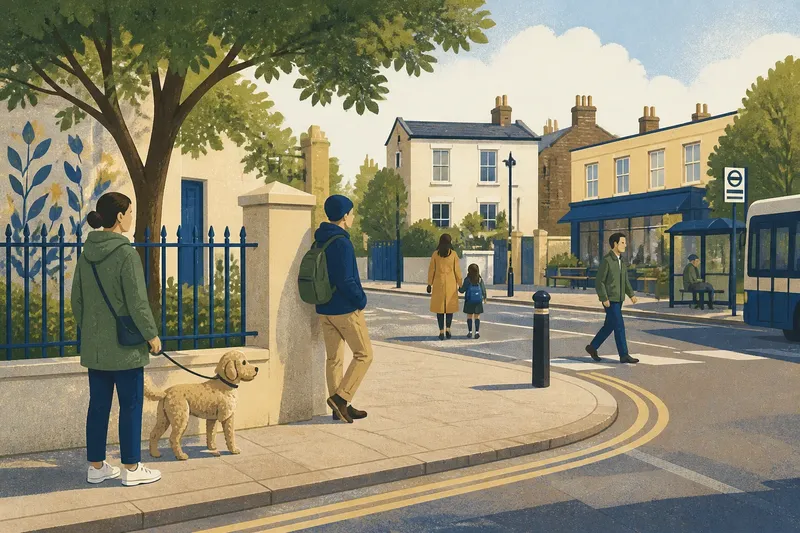
You turn off the high street and spot someone waiting beside the railings at the corner. A few minutes later, another neighbour nods to them on the way past. Why a street corner becomes a meeting point is often less about a formal gathering place than the small ways a familiar route makes people recognisable to one another.
A corner can collect brief encounters without becoming a destination in its own right. Its role grows through repeated use: people pass along the same paths, can tell where they are, and have somewhere unobtrusive to pause. Yet a corner’s meaning depends on who uses it and how. A busy junction that works for a quick greeting may be uncomfortable or inaccessible as a place to wait.
How do repeated routes make people familiar?
People notice patterns when their ordinary journeys overlap. One resident walks a dog before work; another takes a child to school; someone else heads to the bus stop around the same time. They may not set out to meet, but recurring routes bring them into view of one another.
The corner can make that overlap easy to recognise. It may sit where a residential street meets a route to shops, a bus stop, a school gate or a shared green. People travelling from different directions converge there briefly, then continue. Over time, a passing face becomes familiar even if no one knows the person’s name.
This recognition does not require conversation. A glance, a raised hand or a small adjustment to let someone pass can register as a neighbourly exchange. The corner becomes socially useful because it offers a predictable chance to acknowledge people while leaving room for everyone to carry on.
Repeated routes also shape who is likely to meet. A corner on the way to a school may be busy at particular parts of the day, while a junction beside a late-opening café may see activity at other times. It is better to describe these as rhythms than to assume a single, fixed peak: work patterns, school schedules, weather and local habits all change how a place is used.
What makes a corner easy to recognise?
People need a simple way to identify where they mean. It could be the corner by a distinctive tree, the bench outside a library, the end of a wall with a painted mural, or the point where two differently surfaced paths meet. These details act like labels in a shared mental map, even if no sign names the place.
Recognition is strongest when a landmark can be seen from an approaching route and is not confused with several similar features nearby. Its usefulness does not depend on grandeur. A broad tree canopy or a brightly coloured gate may be easier to describe than an impressive building hidden behind parked vehicles.
Landmarks also help people explain where to meet. “By the green railings at the corner” gives someone a more precise cue than “somewhere near the shops”. The cue should be visible from the direction a person is likely to arrive. If it can only be seen after they have passed the corner, it may not help much.
These markers are not neutral for everyone. A person with low vision may rely on a change in paving, a kerb edge or a sound, while a wheelchair user may need to identify the accessible side of the junction. A useful local description can pair a visible feature with a route cue, such as “beside the library, on the level path from the square”. That avoids making a single visual landmark do all the work.
Where can someone pause without getting in the way?
A point of recognition becomes a practical meeting place only if waiting feels manageable. A small setback from the pedestrian flow, a low wall, a bench or a wide pavement can give someone room to stop while others continue past. There is no need for a formal seating area, but the space should not force people to block a doorway, cycle route or narrow path.
Consider the difference between standing at the tip of a crowded junction and waiting a little farther along a broad pavement, where a person can see the crossing and leave a clear route through. The second position may be more comfortable even though it is only a short distance away. As with a bookmark, a modest marker helps you find your place; it does not need to occupy the whole page.
Comfort is shaped by more than room. A corner exposed to wind or rain may suit a quick greeting but not a longer wait. Shade, lighting, noise, traffic and nearby seating affect who feels able to linger and at what times. A place that feels welcoming in daylight may feel uncertain after dark, while an active frontage may make waiting more comfortable for some people and too busy for others.
Access matters too. A dropped kerb, tactile paving or a clear path can determine whether someone can reach the meeting point and wait there safely. Keep the gathering position away from crossing points and maintain a clear route for people using mobility aids, pushchairs or bikes. Where a change to paving, street furniture or access is involved, follow the relevant local rules and the manufacturer’s instructions for any installed item.
Who uses the corner, and for what?
Not every corner serves the same purpose. One may be a convenient place to exchange a greeting on the way home. Another may work as a rendezvous before a walk to the park. A corner near a school could briefly bring together carers, children and neighbours; one beside a transit stop may be used by people who do not know one another at all.
It helps to distinguish between passing, waiting and gathering. Passing means people share the space for a moment but keep moving. Waiting means someone expects another person or service to arrive. Gathering means several people stay together for a while. A corner may support one of these uses, or shift between them over the day.
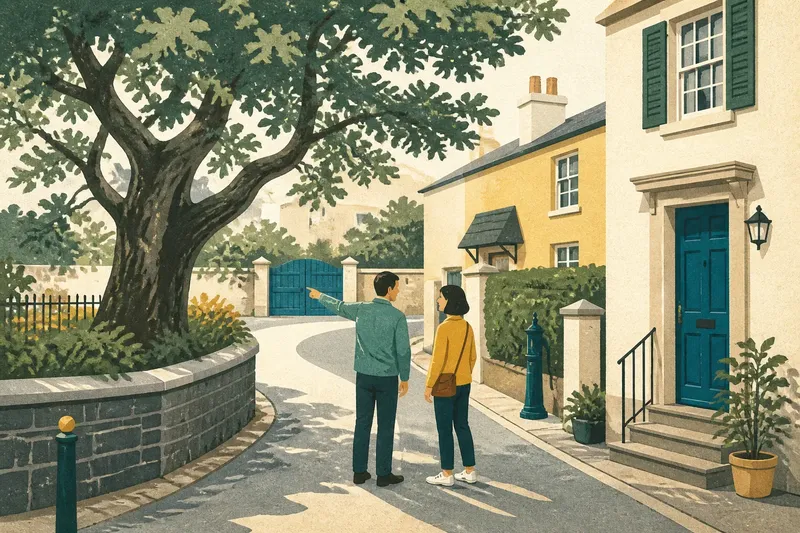
Say you are arranging to meet a neighbour before walking to a local garden. The junction has a visible blue gate and a wide pavement along one side, but the opposite corner narrows beside a cycle route. Agreeing to meet by the gate, out of the through-path, gives both people a clear landmark and a place to pause; anyone approaching from another direction can use the gate as their cue. That arrangement suits a short rendezvous, but it would not automatically make the corner appropriate for a larger gathering.
People may also use the same place differently without sharing the same understanding of it. A shop worker might see the corner as part of the entrance, a resident as a route home, and a delivery rider as a turning point. Recognising those overlapping uses helps explain why a seemingly obvious meeting spot can cause friction. One person’s convenient waiting place may be another person’s blocked access.
What questions help explain a meeting point?
How can I tell whether a corner is already used for meeting?
Notice whether people repeatedly pause, look for someone or greet familiar faces, rather than judging by a single visit. Compare what happens at different times and avoid treating a quiet moment as proof that nobody uses the place.
What makes one corner easier to describe than another?
A clear landmark and a straightforward approach make directions easier to follow. A useful description says which side to use and names a feature that can be seen before someone reaches the junction.
Why might a busy corner still be a poor meeting place?
High footfall does not necessarily leave room to wait. Narrow paths, blocked entrances, difficult crossings or a lack of shelter can make a corner unsuitable for lingering, even if many people pass through.
Can a corner matter if people do not stop there?
Yes. A recurring point of recognition can help people orient themselves and notice familiar faces as they pass. Its local significance may come from the repeated encounter, not from anyone staying for long.
Why do some corners never become meeting points?
A crossroads may be too exposed, noisy or difficult to cross. Another corner may have no comfortable place to wait, or a landmark that is hard to see from the approach. A route used by one group may rarely overlap with another’s, so the spot remains useful for navigation but not for social contact.
That does not mean something is missing. Not every junction needs seating or a social role. A corner can work well as a clear turning point, a passage between streets or a place to make a safe crossing. The point is to read what people actually do there rather than assume that visible activity is the only sign of value.
Local habits can also set boundaries. People may prefer to meet at the bus shelter, outside a community hall or under cover at a nearby shop, even if the corner is easier to spot. Familiarity often attaches to the agreed place people already use, not to the spot that looks most prominent on a map.
How does a meeting point change over time?
Its role can shift when a route changes, a business closes, a tree is removed or street furniture is added. The landmark people used to give directions may disappear, while a new feature takes its place. A corner can also become less comfortable if building work narrows the path or traffic patterns change.
Such changes are easiest to understand by looking at the relationship between routes, recognition and pausing. If people still pass through but no longer stop, the space to wait may have changed. If they begin choosing another nearby corner, that may offer a clearer landmark or a less obstructed approach. These are clues about use, not proof of a single cause.
When describing a neighbourhood, be specific about what a corner does and for whom. “A meeting point for people walking to the school” is more useful than calling it the neighbourhood’s natural centre. Why a street corner becomes a meeting point is answered by the fit between familiar routes, a recognisable cue and a place to pause—and that fit can be strong for one group, limited for another, or change with the day.
Next time you arrange to meet someone locally, choose a feature they can spot from their approach and a waiting place that keeps the route clear. That small choice makes the corner easier to share, whether the meeting lasts a moment or simply begins with a familiar nod.