The Local Landmark That Does Not Need a Plaque
A local landmark can be an unmarked tree, post or painted door. Learn to recognise how repeated directions and shared names give it local meaning.
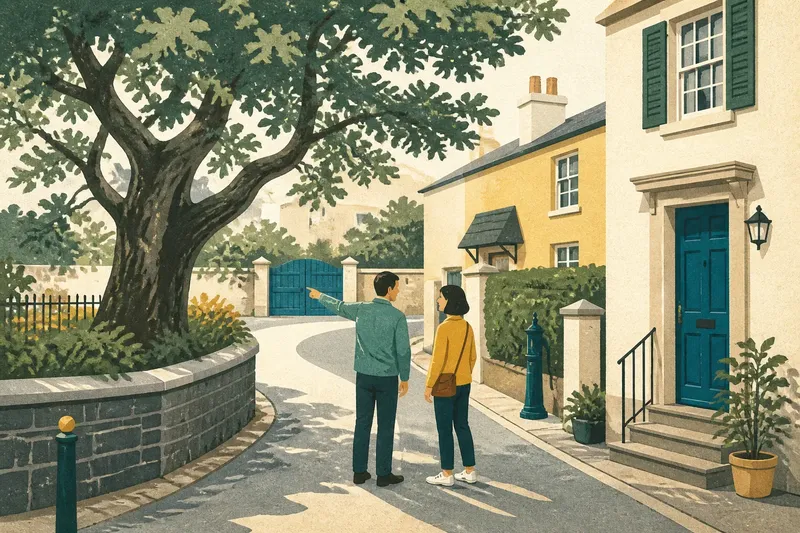
You are halfway down a residential street when someone says, “Turn left at the blue gate.” There is no street sign for it, and the gate has no plaque. Still, the direction makes sense to the people who use it. A local landmark can be an ordinary object that neighbours repeatedly recognise and use to describe where they are.
Look beyond official signs and commemorative markers. A distinctive tree, a painted utility box, a low wall or a doorway with an unusual canopy may carry local meaning through habit. The useful question is not whether the object is important in an official sense, but whether people use it to locate, explain or remember a place.
What makes an unmarked local landmark recognisable?
Start with visible details. A landmark is easier to recognise when it stands apart from its surroundings: a twisted trunk among straight ones, a bright door on a muted row, or a stone post at the edge of a path. The feature does not need to be grand. It needs to be distinct enough for someone to describe without a formal name.
Notice how people refer to it. They might say “past the leaning birch” or “opposite the house with the green shutters”. Such phrases turn appearance into a practical address. The object becomes a local reference point because a listener can picture it and find it.
These landmarks are often easiest to spot while walking at an unhurried pace. Look for objects that appear in more than one kind of conversation: directions, meeting arrangements, delivery instructions or recollections of a nearby change. A single striking object may catch the eye; repeated use suggests that it has become part of the neighbourhood’s shared vocabulary.
How do repeated directions create local meaning?
Directions reveal how people mentally organise their surroundings. A route might be described in relation to a painted drain cover, a churchyard wall or a particular shop entrance, even when a street name would be more formal. That choice can make the journey easier to imagine. It can also show which details remain stable in daily use.
Listen for the small words around a landmark. “Beyond”, “opposite”, “just past” and “by” place it in a route. If people use the same object to explain several destinations, it is doing more than decorating the street: it is helping them give the neighbourhood a practical shape.
Repeated directions need not mean everyone uses the same phrase. One person may call a structure “the old pump”, while another says “the stone thing by the path”. If both descriptions lead listeners to the same place, the object is recognised even without a settled name. Familiarity can be stronger than naming precision.
Think of it like a bookmark in a well-used book. The bookmark is not part of the printed text, but it helps readers return to a particular page. An unmarked landmark can work similarly: it gives people a shared way to return to a point in the local landscape.
Which ordinary objects are worth noticing?
On a walk, keep an eye out for features that are both distinctive and fixed in place. These may include:
- Trees and planting: a broad-rooted tree, a clipped hedge that turns a corner, or a planter cared for by nearby residents.
- Street furniture: a bench with a painted back, a post with several old stickers, or a public clock that is easy to see from the pavement.
- Building details: a brightly coloured door, a carved lintel, unusual shutters or a gateway set back from the street.
- Ground features: a patterned drain cover, a change in paving or a marked boundary between two paths.
- Small structures: a disused pump, a low stone marker or a shelter whose appearance stands out from nearby buildings.
Record what you can actually see rather than guessing at an object’s history. “Blue gate beside the narrow lane” is a useful field note; “old boundary gate” is an interpretation unless you have a reliable reason to know that. The distinction keeps observation clear without stripping the place of interest.
How can you tell whether neighbours share the reference?
Do not assume that a feature is a landmark just because it catches your attention. Look for signs of shared recognition, such as more than one person using it in directions or a familiar nickname appearing in local conversation. You can ask a simple, open question: “How would you describe this stretch to someone visiting?” Then listen for the objects people choose.
Pay attention to differences as well as agreement. A resident who has lived nearby for years may use a name that a newer neighbour has never heard. A local reference can belong to one group, generation or route rather than the whole area. That does not make it false; it makes its reach more specific.
Avoid treating a passing remark as proof of a universal name. Someone may be using shorthand that makes sense only to a particular household or group of friends. If the reference matters to your account, note who uses it and in what context, rather than presenting it as the neighbourhood’s official term.
What should you ask about an unmarked landmark?
Can a landmark have more than one local name?
Yes. Different residents may describe the same object by its colour, shape, former use or position along a route. Keep the names distinct in your notes and record who uses each one.
Does a local landmark need to be old?
No. A newer mural, planter or distinctive doorway can become a reference point through repeated use. Its local meaning comes from recognition and habit, not age alone.
How can I describe a landmark without claiming a history?
Write down its visible features and where it sits, then separate those observations from anything someone tells you about its past. Attribute a local name to the person or group who uses it instead of presenting it as an established fact.
What if the object changes or disappears?
Note the change and notice whether people adapt their directions or continue using the old reference. A familiar name may remain in conversation after its original object is gone, which can point to a shared memory rather than a current visual marker.
How do you record a landmark without overstating it?
Make a compact note that separates the object, its location and its use. For instance: “Painted red door on the lane’s eastern side; one neighbour used it to explain the route to the community garden.” This gives a reader something they can picture while keeping the claim within what you observed.
Say you notice a broad tree beside a path and hear two residents refer to it as “the forked oak” when describing nearby homes. In your notes, identify the tree by its split trunk, mark its position in relation to the path, and write that both residents used that phrase. The expected result is a description that makes the reference traceable without implying that every neighbour knows the same name.
Keep a simple sketch or a written sequence of landmarks if the object is difficult to photograph or if its surroundings are more informative than the object itself. A note such as “after the low wall, before the footpath narrows” can preserve the route relationship. Avoid including private details about residents or directing readers through spaces that are not publicly accessible.
When is an ordinary object more than a visual detail?
An object becomes a local landmark when it helps people make sense of where they are, especially when that use recurs. The clearest evidence is practical: someone points to it in a direction, another person understands, and the object appears again in local descriptions. A plaque may explain an official story, but it is not the only way a place acquires significance.
On your next neighbourhood walk, note one unmarked object and the words people use around it. The phrase may be temporary, shared only by a few, or familiar across a wider area. Either way, the local landmark is not just what stands in the street; it is the reference people keep carrying into their directions.